




Exposteam School
The Exposteam schools project was born out of a collaboration between the Department of Political Science at Roma Tre University and the Department of Political Science, Law, and International Studies (SPGI) at the University of Padua. The school’s programme aims to investigate the interconnections among scientific and technological domains, international relations, and other fields. The programme places particular emphasis on the analysis of historical contexts to elucidate contemporary developments and challenges in these fields.
The Spring School in Techno-Scientific Diplomacy is a research laboratory exploring the possibility of creating a new experimental Master’s programme that combines science and diplomacy through strong interaction between experts, academics, diplomats, and students from various techno-scientific disciplines.
In a context in which the international community is increasingly called upon to make rapid, informed decisions, this Spring School aims to give full relevance to the role of science and technology in the international arena.
Source: ExPoSTEAM Diplomacy 2023
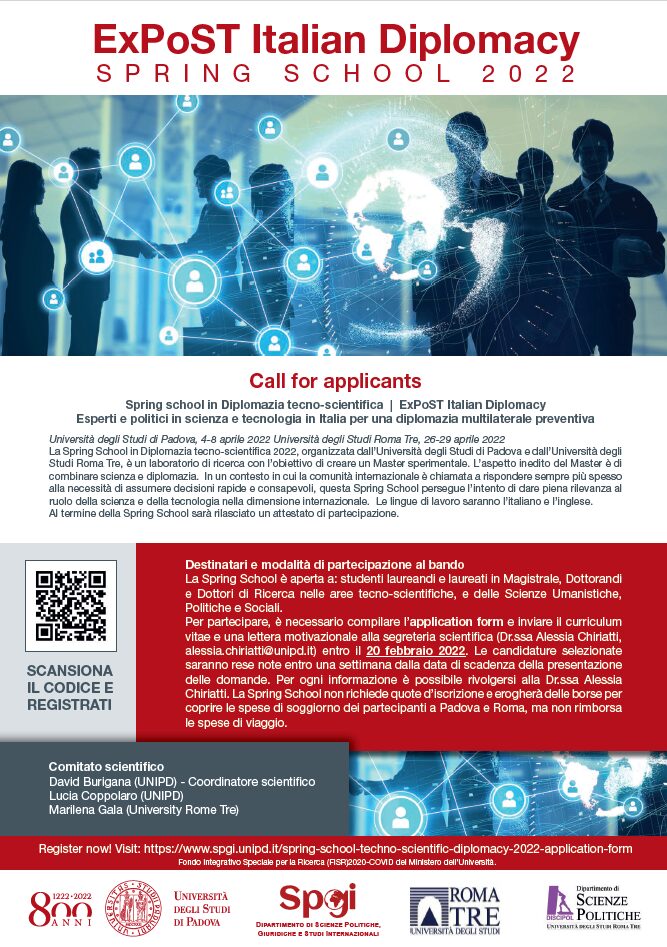
ExPoST Italian Diplomacy
In 2022, the University of Padua and Roma Tre University organised a Spring School in Techno-
Scientific Diplomacy, a research laboratory aimed at creating an experimental Master’s
programme. As a novel aspect, the Master’s programme combines science and diplomacy. In fact,
it aims to provide participants with essential tools for exploring issues related to science,
diplomacy, and decision-making processes in a world of increasing technological density that
requires techno-scientific diplomatic action. In a context in which the international community is
increasingly called upon to make rapid, informed decisions, this Spring School aims to place great
importance on the role of science and technology in the international arena. In particular, Italy has
developed techno-scientific skills in the European and global context that animate experiences of
cooperation and competition in a dynamic diplomatic framework. Based on the experiences
accumulated and analysed through the lens of international history, the examination of
documentary sources and the testimonies that operators, even from the recent past, have handed
down to us, the Spring School aims to offer its participants the opportunity to learn from past
experiences to connect with prospects and create a community of reference thanks to the
involvement of scholars, diplomats and scientists interested in the international context.
The training of course participants will follow an interdisciplinary approach with the following
objectives in relation to techno-scientific diplomacy:
- to provide knowledge on the evolution of the international relations framework and its history from the Cold War to the current scenarios;
- to provide an in-depth overview of diplomacy in bilateral negotiations and multilateral arenas at the European and international level;
- to develop oral presentation (public speaking) and editorial skills (reporting and writing techniques) aimed at deepening negotiation techniques;
- to expand techniques related to hard skills (level of study and knowledge of the topics covered) and soft skills (crisis management, team building, problem solving, research skills, role playing);
- to enrich participants’ CVs by developing professional knowledge and skills supported by an in- depth study of topics related to techno-scientific diplomacy to facilitate their entry into the world of work related to international relations and diplomacy.
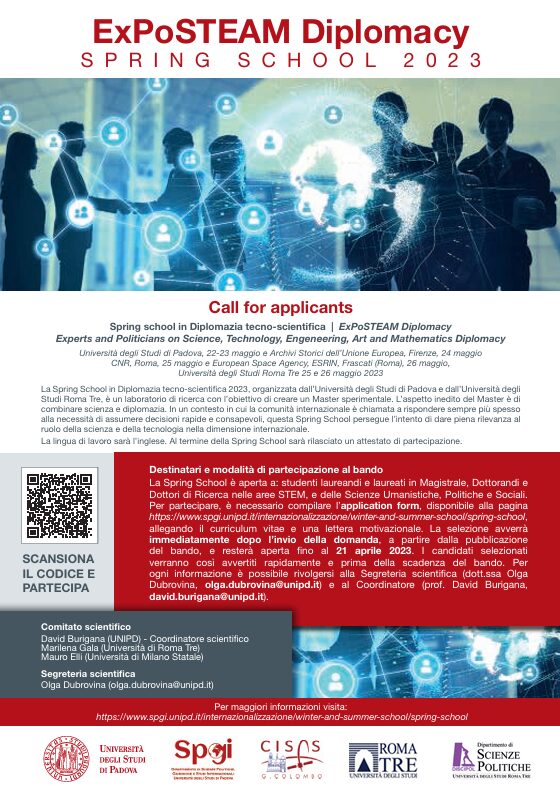
ExPoSTEAM Diplomacy
The Spring School in Techno-Scientific Diplomacy 2023, organised by the University of Padua and
Roma Tre University, is a research laboratory aimed at developing an experimental Master’s
degree programme. The novel aspect of the Master’s programme is that it combines science and
diplomacy. In fact, it aims to provide participants with essential tools for exploring issues related
to science, diplomacy, and decision-making processes in a world of increasing technological
density that requires techno-scientific diplomatic action. In a context in which the international
community is increasingly called upon to make rapid, informed decisions, this Spring School aims
to place great importance on the role of science and technology in the international arena. In
particular, Italy has developed techno-scientific skills in the European and global context that
animate experiences of cooperation and competition in a dynamic diplomatic framework. Based
on the experiences accumulated and analysed through the lens of international history, the
examination of documentary sources and the testimonies that operators, even from the recent
past, have handed down to us, the Spring School aims to offer its participants the opportunity to
learn from past experiences to connect with prospects and create a community of reference
thanks to the involvement of scholars, diplomats and scientists interested in the international
context.
The training of course participants will follow an interdisciplinary approach with the following
objectives in relation to techno-scientific diplomacy:
- to provide knowledge on the evolution of the international relations framework and its history from the Cold War to the current scenarios;
- to provide an in-depth overview of diplomacy in bilateral negotiations and multilateral arenas at the European and international level;
- to develop oral presentation public speakingand editorial skills (reporting and writing techniques) aimed at deepening negotiation techniques;
- to expand techniques related to hard skills (level of study and knowledge of the topics covered) soft skill (crisis management, team buildingproblem solving, research skills, role role playing);
- to enrich participants’ CVs by developing professional knowledge and skills supported by an in- depth study of topics related to techno-scientific diplomacy to facilitate their entry into the world of work related to international relations and diplomacy.
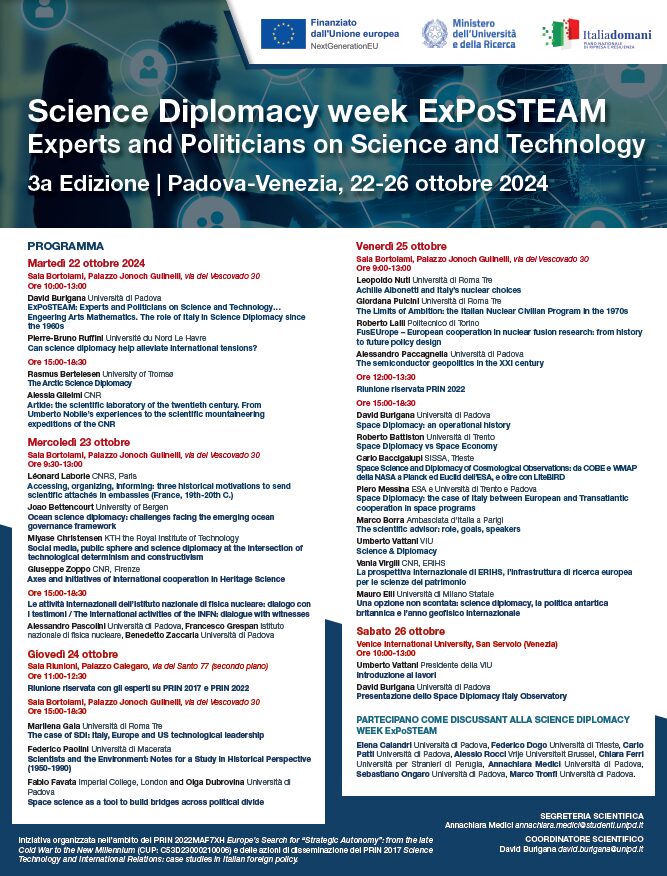
Science Diplomacy week ExPoSTEAM
In 2024, the University of Padua and Roma Tre University organised a Fall School in Techno- Scientific Diplomacy: a research laboratory aimed at developing an experimental Master’s degree. The novel aspect of the Master’s degree is that it combines science and diplomacy. In fact, it aims to provide participants with essential tools for exploring issues related to science, diplomacy, and decision-making processes in a world of increasing technological density that requires techno- scientific diplomatic action. In a context in which the international community is increasingly called upon to make rapid, informed decisions, this Spring School aims to place great importance on the role of science and technology in the international arena. In particular, Italy has developed techno- scientific skills in the European and global context that animate experiences of cooperation and competition in a dynamic diplomatic framework. Based on the experiences accumulated and analysed through the lens of international history, the examination of documentary sources and the testimonies that operators, even from the recent past, have handed down to us, the Spring School aims to offer its participants the opportunity to learn from past experiences to connect with prospects and create a community of reference thanks to the involvement of scholars, diplomats and scientists interested in the international context.
The training of course participants will follow an interdisciplinary approach with the following objectives in relation to techno-scientific diplomacy:
- to provide knowledge on the evolution of the international relations framework and its history from the Cold War to the current scenarios;
- to provide an in-depth overview of diplomacy in bilateral negotiations and multilateral arenas at the European and international level;
- to develop oral presentation public speakingand editorial skills (reporting and writing techniques) aimed at deepening negotiation techniques;
- to expand techniques related to hard skills (level of study and knowledge of the topics covered) soft skill (crisis management, team buildingproblem solving, research skills, role role playing);
- to enrich participants’ CVs by developing professional knowledge and skills supported by an in- depth study of topics related to techno-scientific diplomacy to facilitate their entry into the world of work related to international relations and diplomacy.