




Events SPGI
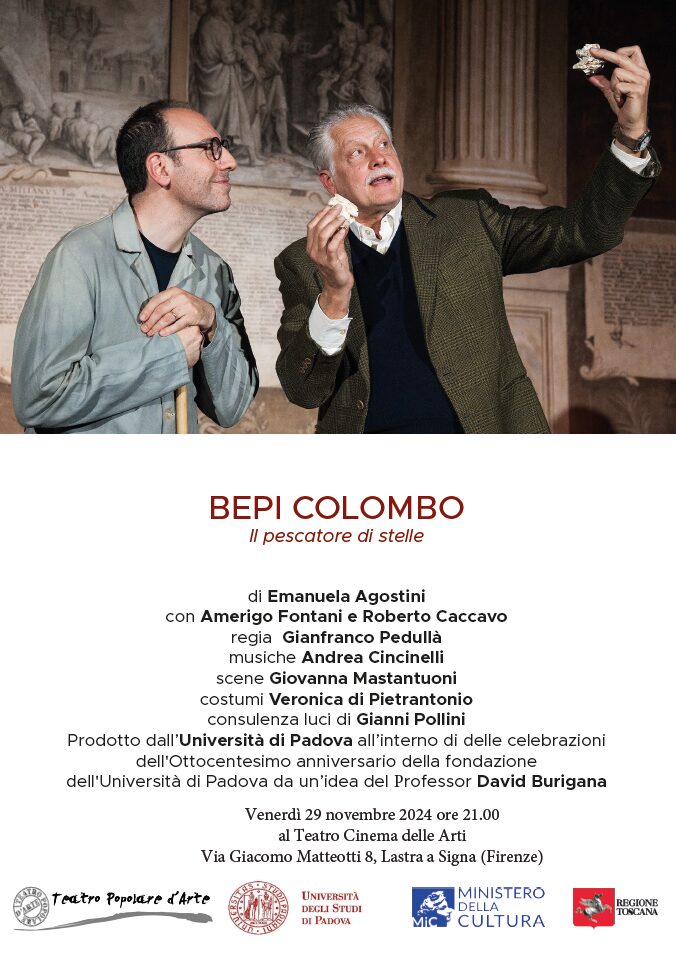
Venerdì 29 novembre 2024 ore 21.00
BEPI COLOMBO
Il pescatore di stelle
The University of Padua has paid tribute to Giuseppe Colombo, universally known as Bepi Colombo, a mathematician, physicist, engineer, and astronomer whose work made fundamental contributions to planetary science. It does so through the theatrical production Bepi Colombo, The Star Fisherman. The performance, based on an idea by Professor David Burigana, was conceived as part of the celebrations marking the 800th anniversary of Padua’s University foundation. It is dedicated to the figure of Bepi Colombo (1920–1984), whose contributions, among other achievements, profoundly shaped the history of space exploration. In his Padua study, already suffering from the illness that would eventually lead to his death, the scientist confides in a journalist fascinated by both his human story and the power of his scientific intuition. The narrative unfolds through a retrospective journey across the years, guiding the audience through the places touched by Colombo’s work: from the University of Padua to the Smithsonian Institution in Massachusetts, from ESA’s Paris offices to NASA’s Jet Propulsion Laboratory, from the confines of his study to outer space itself. A tireless, itinerant scholar in constant motion—at once rigorous and visionary, solitary and outgoing—Colombo perceived scientific research as a responsibility toward the enrichment of all humankind. In the midst of the Cold War, he dared to imagine greater cooperation among world powers to confront global challenges, including planetary warming. This initiative forms part of the project “The University of Padua and Space: From Robotic and Human Space Exploration to Science Diplomacy”, coordinated by David Burigana, Professor at the University of Padua, with scientific consultancy by Enrico Lorenzini, and carried out under the patronage of the Department of Political Science, Law and International Studies (SPGI) and the CISAS – Giuseppe Colombo Centre for Space Studies and Activities.
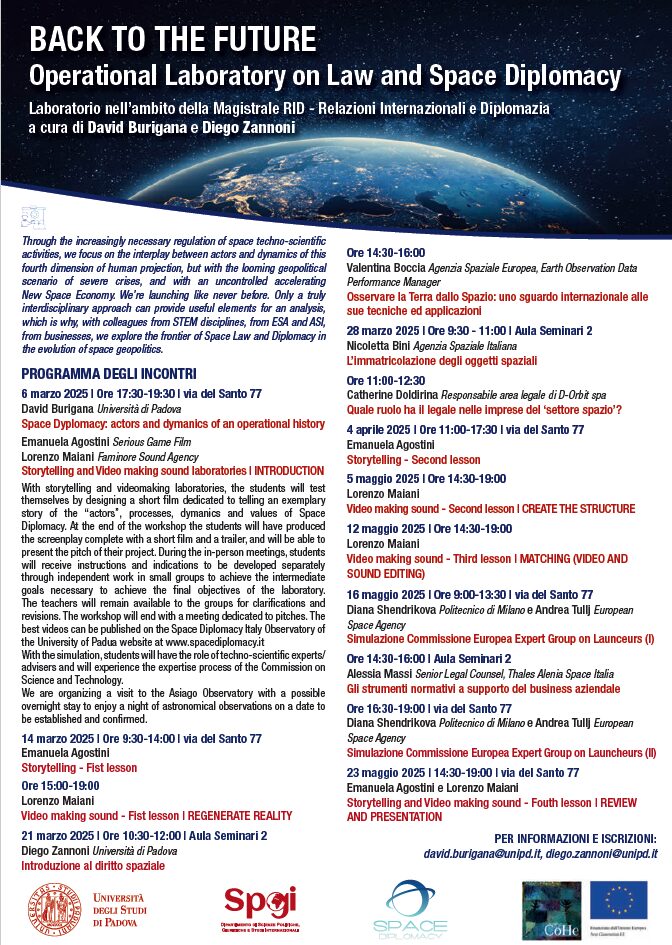
BACK TO THE FUTURE Operational Laboratory on Law and Space Diplomacy
6 March – 23 May 2025 | University of Padua
BACK TO THE FUTURE: Operational Laboratory on Law and Space Diplomacy
Through the increasingly necessary regulation of space-related techno-scientific activities, Back to the Future is a laboratory within the Master’s Degree Programme in International Relations and Diplomacy (RID). Curated by David Burigana and Diego Zannoni, it addresses this fourth dimension of human projection at a time marked by an increasingly tense geopolitical landscape and by the uncontrolled acceleration of the New Space Economy.
Scientific coordinators: Prof. David Burigana and Prof. Diego Zannoni
Conferenza
THE POLES, AN INTERDISCIPLINARY TOOL FOR ADVANCED TRAINING IN SCIENCE DIPLOMACY
Organized by: Department SPGI (Political Science Law and International Studies), University of Padua, Italy
Speakers:
- David Burigana, Professor, University of Padua, Italy: The Italian Long March To Poles: An Operational History
- Elena Calandri, Professor, University of Padua, Italy: The Poles And The Italian Approach To European Construction In A Changing World
- Alessandro Paccagnella, Professor, University of Padua, Italy: Microelectronics and the Poles Geopolitics
- Umberto Vattani, Ambassador, Venice International University, Italy: Italian Diplomacy from Science to Poles
- Rasmus Gjedssø Bertelsen, Professor, UiT – The Arctic University of Norway
- Federica Scarpa, Dr, IACN-Icelandic Arctic Cooperation Network
The history and geopolitics of the Arctic must be included in the more general framework of Science Diplomacy not only because it is one of the notable examples, but for the multiplicity of disciplines and technological typologies it involves. Similarly, this is what happens for Space, the fourth dimension of human exploration, but as the Space Economy shows due to the dependence on satellites for innovation in communications and Earth Observation applications. It is no coincidence that the Poles are not only the object of experimentation and use of space activities. Due to their positioning, they hold two of the most strategic satellite data reception bases, as well as being a place of use and experimentation for the frontier of microelectronics. Just two examples we’ll talk about. However, it is necessary to proceed with a truly interdisciplinary approach, that is, collaboration between techno-scientists and political scientists. The approach we start from is that of the history of the evolution of the international context and the positioning of Italy (D. Burigana, E. Calandri) but applying the concept of operational history to the Arctic and Antarctic, i.e. identifying in the past some elements – actors, dynamics – which can suggest trajectories on the present time. Interdisciplinarity is given by the relationship with fellow scientists, as in the case of Alessandro Paccagnella, physicist, world expert on the effect of radiation on chips, and with whom we have opened a course on Microelectronics and Globalization, and a Master’s in Science, Technology and resource management in the international context where the geopolitical role of the Poles is addressed. However, a strong interaction is needed with the students who participate not in courses, but in learning laboratories because we apply with them – in the schools, in the Master, in the courses – a methodology continuously updating topics, and analyzes since it is based on a communicative interaction with students playing simulation and storytelling workshops. It is at this point that the participation of witnesses from the recent past and actors of the present time who show the dynamics of Science Diplomacy, such as Ambassador Umberto Vattani, becomes essential. In this framework, we have started an oral history project, opening two new series of interviews on Science and Space Diplomacy at the Historical Archives of EU (Florence, Italy), because they are specialized in archival and oral history funds on the history of European construction, not only of the EU institutions. They have the archives from the European Space Agency and the European Science Foundation for example. The students participate in carrying out the interviews. In the renewed attention to Science Diplomacy by the Minister of Foreign Affairs and International Cooperation with the transition from 22 to more than 60 scientific and space attachés, for the first time the attachés’ conference was held outside the Ministry in a university, in Padua (2023), and at the Polytechnic of Turin (2024). In view of these two conferences, the Venice International University (VIU), a consortium of Italian and foreign universities, wanted by the President of the Republic Carlo
Azeglio Ciampi, and chaired by Ambassador Vattani, was the venue for two preparatory meetings with diplomats, academics, representatives of companies interested in Science Diplomacy from which the commitment to create two Observatories emerged, one on Science Diplomacy sciencediplomacy.it and one on Space Diplomacy spacediplomacy.it.