




The Mediterraneo Wargame, developed under the aegis of Professor Andrea Bernardi at the Centre for Higher Defence Studies, Graduate School (CASD), serves as a strategic framework for participants who take on the role of political decision-makers and international negotiators. The primary objective of this simulation is to enable participants to embody the states of the various Mediterranean nations, understand, and articulate their respective policies and domestic agendas.
This initiative emphasizes the intricate dynamics of diplomatic and political maneuvering, encapsulating the negotiation processes that underpin international relations. Mediterraneo Wargame operates as an innovative fusion of military and scientific domains, highlighting the need for collaboration between them to pursue national interests effectively.
The educational objectives of the laboratory are to:
• Explore strategic-level issues and topics related to national and international defence and security policy.
• Individually and collectively develop negotiation skills, leadership, and strategic vision.
• Understand the role of scientific, military, and industrial diplomacy.
• Examine the crucial role of the Mediterranean concerning: economic growth; maritime transport routes; scientific cooperation; migration flows, labour markets, and demographic imbalances; strategic competition between liberal democracies and autocracies; telecommunications and energy infrastructures; sustainability and climate change.
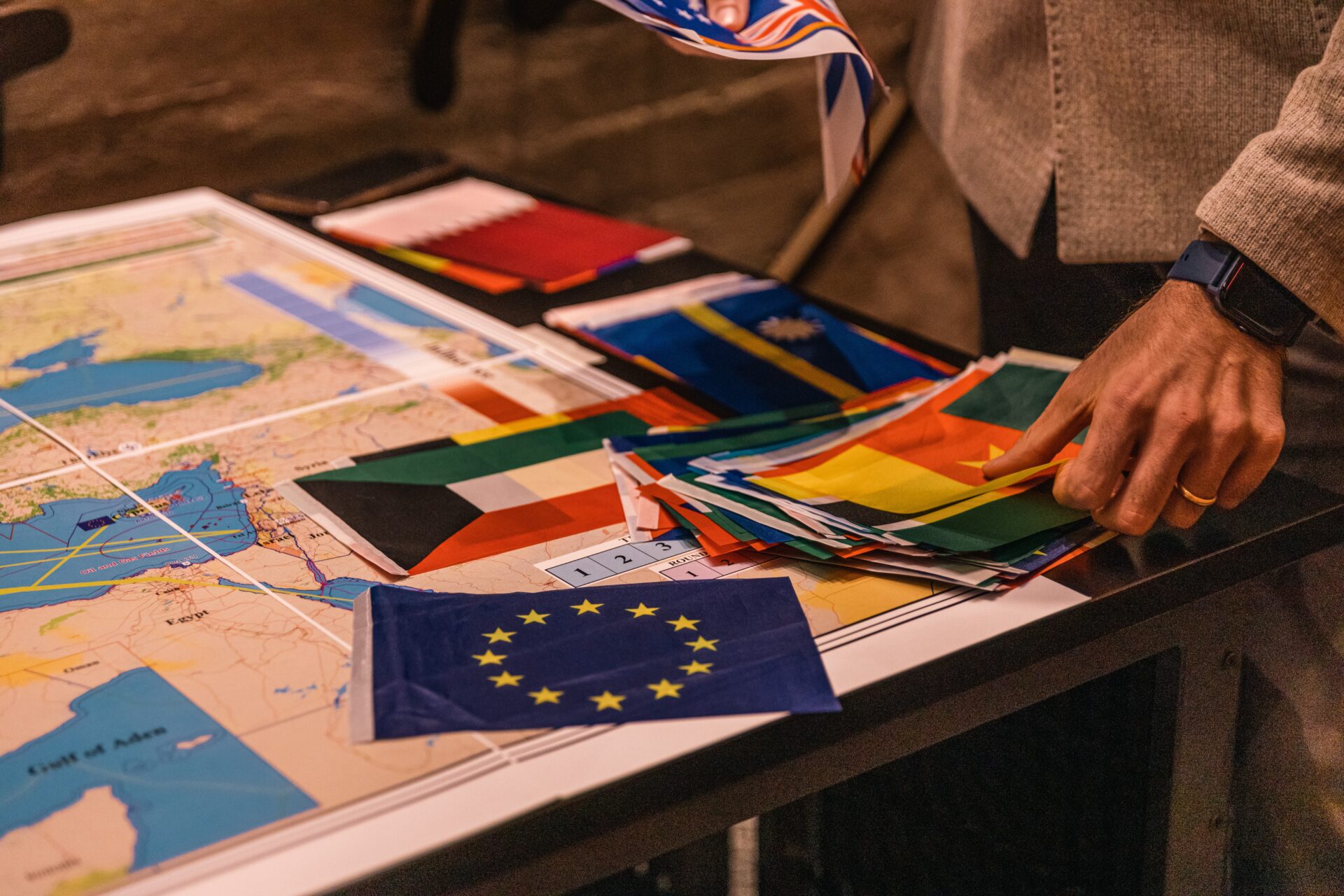
The inaugural presentation of Mediterraneo Wargame took place during the Erice School, where scientists engaged in complex negotiations to achieve scientific objectives through multilateral agreements. The wargame originated as “Mediterranean: Science & Diplomacy in the Wider Mediterranean”. It is a matrix-based game designed for the School of Science and International Diplomacy at the Ettore Majorana Centre in Erice. The primary purpose of the game is to examine how scientific influence can foster peaceful cooperation among nations. The game’s time horizon is long-term, spanning between 10 and 20 years. In the initial version of Science & Diplomacy, participants were encouraged to develop science diplomacy campaigns directed at other nations. Science acts as a vital instrument, and scientific capability is a key measure of success. Financial resources (represented by yellow tokens) and scientific resources (represented by blue tokens) are used to achieve national and collective objectives, including the aspiration for a prosperous, free, and secure Mediterranean region. These resources can be invested in scientific, industrial, or military projects and can also be allocated to finance influence-building initiatives. Although simplified, the wargame rules allocate financial and scientific resources in proportion to the real capabilities of the nations represented. The wargame materials and preparatory readings provide participants with foundational knowledge of the region’s diplomatic, scientific, military, and institutional context. Designed for educational purposes, the wargame is an immersive learning experience based on learning by doing. The map itself, constantly monitored by participants, contains helpful information (submarine cables, migration flows, scientific and military infrastructures, pipelines, etc.) and enables reflection on the evolving scenario as counters (tokens) representing events, actions, and injections accumulate1.
A significant evolution of the wargame took place during a subsequent simulation in Rome from 2 to 5 December, held in conjunction with the IASD course at the Institute for Higher Defence Studies. This iteration broadened its scope to include cooperation on armaments development and technological progress, recognizing industrial capacity as a vital strategic asset in diplomatic exchanges. The IASD course is attended by senior officers and generals of the Armed Forces, as well as senior civil servants and executives from the defence and security industries. The educational objectives of the IASD course included implementing the changes envisaged by the original designers, Andrea Bernardi and Paolo Scannapieco, in collaboration with Adriano Pantaleo, Giuseppe Tamba, Francesco Marradi, and Emanuele Farruggia. The new rules and updated materials shift the focus from science to the defence industry. European nations are invited to invest economic and scientific resources to develop a robust defence industrial base. Moreover, these nations must prioritize national success by achieving collaborative industrial objectives. The wargame, renamed for the occasionMediterraneo: Science & Defence Industry”, features a refined map and a dedicated module focused on the process of European industrial integration. The resource dashboard has been enhanced: in addition to the yellow areas representing revenues from foreign economic activities and the blue areas indicating human capital and scientific infrastructure, green areas now highlight currently available military capabilities2.
As a pedagogical tool, Mediterraneo Wargame Mediterraneo effectively clarifies the processes underlying international diplomacy, as participants are often required to negotiate rather than resort to displays of military force. This cooperative paradigm proves essential in fostering diplomatic solutions. The Rome session involved approximately 70 participants guided by 14 facilitators, who provided information on the simulation framework and rules.
The country groups competed to win. They fully embraced their roles and demonstrated strong strategic and negotiation skills. The evaluation criteria for the groups were:
• Consistency between the country profile and actions
• Negotiation skills and teamwork
• Quality and quantity of national objectives achieved
• Contribution to the European defence industry (new projects launched)
• Combined exercise of scientific, industrial, and military diplomacy
One of the key missions of the wargame is to reaffirm the Mediterranean’s significance as a political and strategic nexus, influential not only for the European Union but also on the global stage. The integration of defence projects has generated considerable interest among various stakeholders, further illustrating the wargame’s role as a crucial educational tool. The wargame skillfully captures the often complex interactions among scientific disciplines, diplomatic practices, and industrial strategies in the military sector3.
Looking ahead, the Mediterraneo Wargame is poised for further evolution, capable of adapting to the constantly changing landscape of international relations and contemporary conflicts. Its remarkable flexibility and responsiveness to emerging trends underscore its core strengths, enabling it to focus on achieving the strategic educational objectives envisioned by participants and experts alike. With its continued development, the simulation remains a vital channel for understanding the interplay between politics, science, diplomacy, and military strategy in the modern world. While the representation of the military sphere has been made more realistic, “Mediterraneo” remains a game of peace.
Andrea Bernardi e Sebastiano Ongaro
1 Press note, Wargame IASD 2024–25 by Professor Andrea Bernardi, Rome, 19 December 2024. https://www.difesa.it/smd/casd/news/centro-alti-studi-difesa-wargame-mediterraneo/61078.html
2 Ibidem.
3 MEDITERRANEO: Science and Diplomacy nota del Professor Andrea Bernardi.
